
- This event has passed.
4/16/2026: Exploring the role of nitrogen substrate availability in the ecology of Microcystis-dominated CyanoHABs
Please join us for a Great Lakes Seminar Series – subscribe!
Time: 12:00pm – 1:00pm ET
Location: Virtual or NOAA Great Lakes Environmental Research Laboratory, Lake Superior Hall*
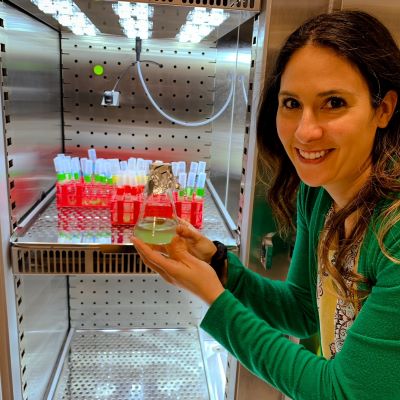
Presenter: Jenan Kharbush, Assistant Professor, University of Michigan Department of Earth and Environmental Sciences
Title: Exploring the role of nitrogen substrate availability in the ecology of Microcystis-dominated CyanoHABs
About the presentation: “Nitrogen availability” refers to the amounts of biologically usable nitrogen forms relative to demand by the biological community. In cyanobacterial harmful algal blooms (CyanoHABs) dominated by the non-diazotrophic cyanobacteria Microcystis aeruginosa, nitrogen availability is critical for the production of the nitrogen-rich toxin microcystin, and may also play a role in shaping M. aeruginosa strain composition and relative abundance of toxic and non-toxic strains. During the annual CyanoHAB in Western Lake Erie, both the dominant form of nitrogen (organic vs. inorganic) and M. aeruginosa strain composition shift as the bloom progresses, as does the heterotrophic bacterial community composition in M. aeruginosa colonies. Recent metagenomics and culture-based work suggests that some of these heterotrophs may be involved in nitrogen acquisition and cycling processes with Microcystis. In this talk I will discuss some of our recent efforts to understand the influence of nitrogen form on Microcystis bloom ecology, via both strain-specific adaptations and interactions with other community members such as heterotrophic bacteria. This includes examining how nitrogen form influences exometabolite production in cultured M. aeruginosa strains, as well as using nano-secondary ion mass spectrometry (nanoSIMS) to measure how cell-specific nitrogen uptake in field communities changes with bloom phase.
About the speaker: Jenan is an Assistant Professor in the Earth and Environmental Sciences Department at the University of Michigan. She earned her PhD in Chemical Oceanography from the Scripps Institution of Oceanography, where she developed an appreciation for the complexity of microbial life and the outsized influence microbes have on their environment. At U-M, her research group studies how aquatic microorganisms, particularly phytoplankton, acquire and use nitrogen, including during CyanoHABs. They combine laboratory culture experiments with field-based environmental observations to link cellular-level nitrogen cycling processes to large-scale geochemical patterns in both modern and ancient environments.
_____________________________________________________
*IMPORTANT VISITOR INFORMATION
As of July 2025 the GLERL facility can no longer accept visitors for the Great Lakes Seminar Series due to staffing shortages. Please attend virtually using the link above.
All seminar attendees are required to receive a visitor badge from the front desk at the NOAA Great Lakes Environmental Research Laboratory facility. Attendees need to present a valid U.S. photo ID or green card. If you are a Foreign National, we encourage you to attend virtually. For questions regarding building access, please email Margaret Throckmorton at [email protected]. Additional questions? Contact Margaret Throckmorton: [email protected]; visit ciglr.seas.umich.edu for more information.