
Great Lakes Social-Ecological Indicators
 Dates: August 2 – 4, 2026
Summit lead: Mike Shriberg (U-M Water Center/SEAS)
Steering committee members: John Bratton (LimnoTech); Patrick J. Doran (The Nature Conservancy, Midwest Division); Sophee Langerman (National Wildlife Federation, Healing Our Waters Coalition); Meghan Klasic (University of Minnesota); Josie McCarthy (U-M Water Center/SEAS); Sarah Miller (U-M Water Center); Jess Rudnick (University of Illinois Extension); Julie Simmons (NOAA); Tennessee Swearingen (U-M Water Center/SEAS); Katie Williams (University of Minnesota-Duluth)
CIGLR Research Theme: Protection & Restoration of Resources
Background: The 2026 CIGLR Great Lakes Social-Ecological Indicators Summit was organized in response to growing calls to understand and integrate human dimensions and well-being into Great Lakes ecosystem-based management programs to improve the efficacy, equity, community support, and long-term sustainability of restoration investments. Ecosystem-based management approaches often identify and monitor “indicators” that measure progress toward stated management goals and can be used to assess how management and policy approaches affect progress toward these outcomes. Many frameworks exist for selecting indicators that are conceptually valid, scientifically grounded, sensitive to change, measurable, and understandable; yet these efforts have largely focused on biophysical indicators rather than social or human well-being indicators.
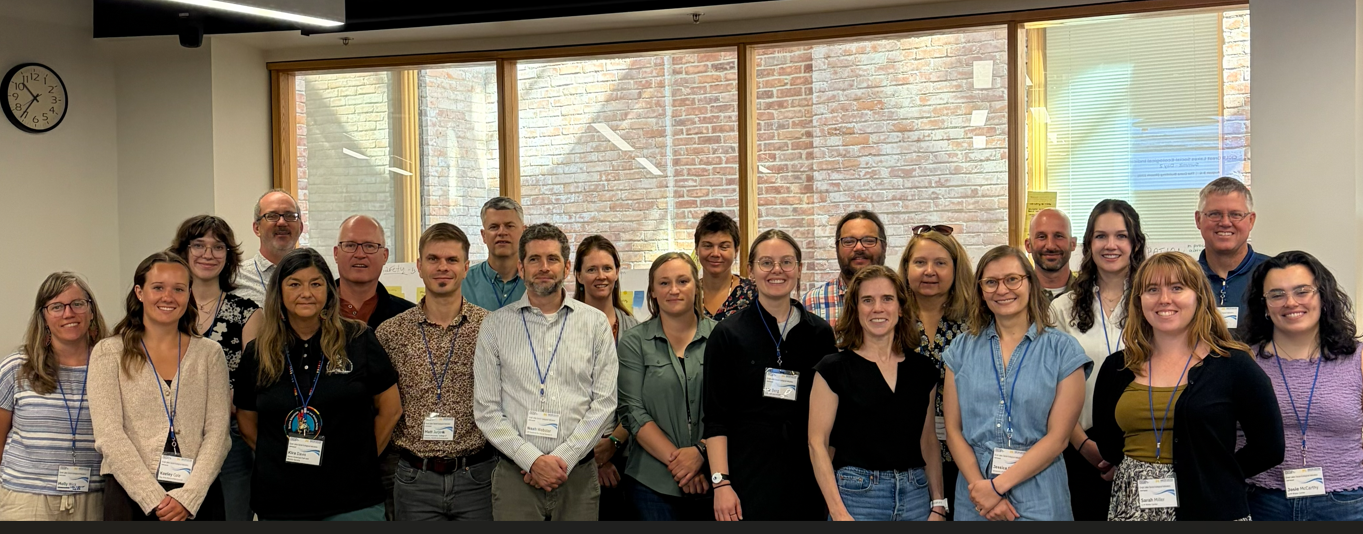
The University of Michigan hosted the 2026 CIGLR Summit, bringing together participants to explore Great Lakes social-ecological indicators. Photo Credit: Margaret Throckmorton.
The Laurentian Great Lakes are no exception to the focus on biophysical indicators, with decades of work by U.S. and Canadian government agencies, researchers, and stakeholders to monitor various biological, chemical, and physical indicators that are used to describe basin-wide trends and assess progress toward the restoration objectives outlined under the Great Lakes Water Quality Agreement (GLWQA), Great Lakes Restoration Initiative (GLRI), and other initiatives, laws, or programs. As with so many other social-ecological systems (SESs), monitoring efforts include very few social or human well-being indicators.
In recent years, a community of social science scholars, practitioners, and advocates focused on understanding the social dynamics of the Great Lakes and demonstrating the importance of accounting for human dimensions in the design of environmental programs has burgeoned. The summit marks the fourth convening in recent years to advance shared understandings and build a collaborative community able to integrate human dimensions into Great Lakes management. While prior gatherings have identified concepts for action and important priorities for the U.S. EPA, IJC, and other agencies, the gatherings have not synthesized and tailored the frameworks, measurement tools, or data sources that will be necessary to track human dimension indicators in the Great Lakes. This CIGLR Summit uniquely contributed to this growing lineage of work by actively addressing this gap and aiming to produce usable tools.
Description: The Great Lakes Social-Ecological Indicators Project, supported by the Cooperative Institute for Great Lakes Research (CIGLR), had numerous objectives:
-
- Identify priority human dimensions indicator categories and specific candidate indicators that are adaptable to local contexts, while informative at the regional scale.
- Advance ideas for a framework and decision-support tool that provides the necessary support to Great Lakes stakeholders and local resource managers to self-select relevant indicators according to their own community-specific or management context needs. The development of these tools aims to promote adoption of human dimension indicators across the Great Lakes basin.
- Build collective understandings of the processes, drivers, impacts, and management challenges related to management objectives that inform tool and resource creation and aid implementation of selected human dimension indicators across the basin.
- Build collaboration between managers and stakeholders to drive adoption of the use of indicators developed through this project and foster a community that collaboratively works to incorporate indicators into Great Lakes governance and management decision-making.
Project initiatives leading up to and culminating in the August 2026 Summit made great strides in advancing all objectives and identifying important paths forward to continue to advance this work and its implementation. Here we provide quick highlights of the key advances made around each objective. For additional details, please see corresponding sections in the full report.
Objective 1: Priority indicator categories and potential specific indicators were identified by compiling human dimension indicators monitored around the Great Lakes and across other relevant social-ecological systems (SESs), and organizing these indicators around human dimensions relevant to the Great Lakes management objectives. Summit participants then had the opportunity to brainstorm additional potential indicators of interest.
Objective 2: Feedback on valuable frameworks and decision-support tools was gathered throughout the pre-summit processes, including two workshops (online and at the International Association for Great Lakes Research conference), a survey and multiple rounds of review by the Steering Committee. During the summit, participants identified initial priority indicators for four Great Lakes Restoration Initiative (GLRI) management objectives (M.Os). Further analysis and synthesis of these indicators is anticipated, potentially informing a white paper or publication and the development of adaptable decision-support tools to support stakeholders and resource managers across the Great Lakes basin in applying indicators to their specific contexts and needs.
Objective 3: Challenges and barriers to indicator adoption and implementation were identified throughout the pre-summit process. During the summit, participants identified initial priority indicators across four Great Lakes Restoration Initiative management objectives (M.Os) and collaboratively developed shared definitions. Participants mapped how these priority indicators could be used by specific audiences and stakeholder groups to inform actionable decision-making and be assessed and measured. They also identified opportunities to integrate
priority indicators into existing efforts and align them with stakeholder group priorities. Discussions focused on potential next steps to address implementation barriers and strengthen interorganizational coordination to support the integration, adoption, and practical application of priority indicators.
Objective 4: The project engaged 75 people across 2 pre-summit convenings and the in-person August 2026 Summit. The Summit convened 25 individuals, representing 21 organizations across 7 sectors. See Appendix G for the summit attendee list.
Next Steps: Participants identified several priorities for advancing Great Lakes human dimensions indicators beyond this initial CIGLR project funding at the near-term, medium-term, and long-term stages. Near- to medium-term work will likely include:
-
- Refining the highest-priority indicator categories and candidate indicators identified during the August Workshop by clarifying their intended audiences, terminology used, measurement approaches, and the scales (spatial or social) at which they are appropriate to implement.
- Drafting a white paper or other publication (via a committee including Summit participants) releasing the refined, prioritized indicators from the August workshop.
- Gathering feedback through existing institutions and convenings, engaging agencies, Tribes, non-governmental organizations, and community groups to build acceptance and awareness of these efforts.
- Piloting prioritized indicators and developing case studies and practical tools for local resource managers