Alumni News
Diving Deep into Food Webs with Anna Schmidt
..
2019 Great Lakes Summer Fellow
2020 – 2021 Food Web Laboratory Analyst
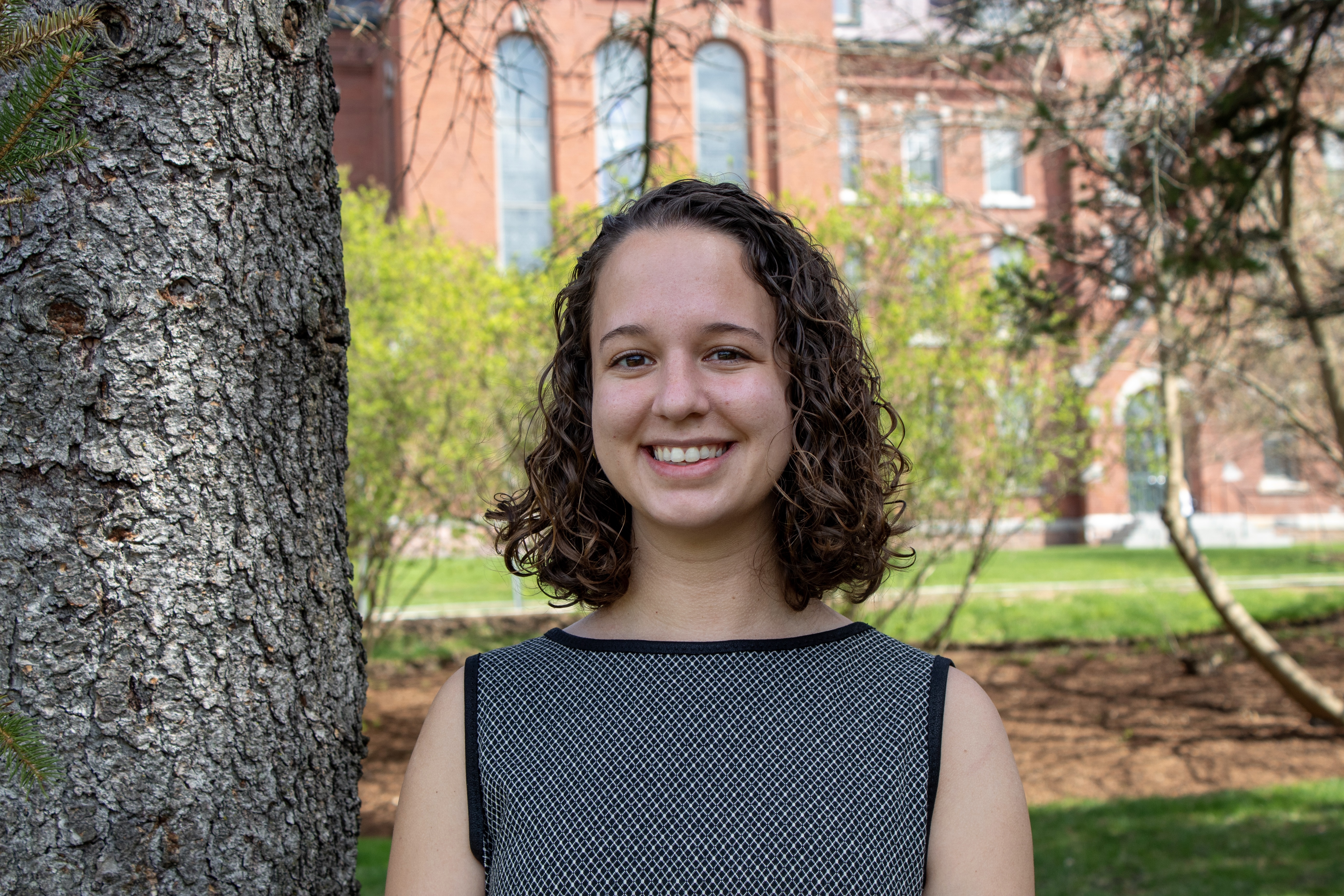
Anna Schmidt, 2019 CIGLR Summer Fellow and 2020-2021 CIGLR Food Web Laboratory Analyst.
Anna Schmidt first joined CIGLR in 2019 as a Great Lakes Summer Fellow, where she advanced research on Mysis in Lake Michigan. Mysis, also known as opossum shrimp, are small, shrimp-like crustaceans that play a vital role in the Great Lakes food web by transferring energy from plankton to fish. Using the Multiple Opening and Closing Net and Environmental Sensing System (MOCNESS), she helped measure the fine-scale vertical distribution, size structure, and biomass of Mysis. Her project addressed important research questions about seasonal and depth-related changes in Mysis populations, their daytime behavior in the water column, and the performance of new sampling technologies. It also contributed valuable insights to broader efforts linking Mysis dynamics to fisheries acoustics and food web modeling. Building on this experience, Anna returned to CIGLR as a Food Web Laboratory Analyst from 2020 to 2021, collaborating with Drs. Michael Fraker (formerly CIGLR), Ed Rutherford (formerly NOAA GLERL), and Doran Mason (formerly NOAA GLERL). In this role, she organized and conducted field sampling and laboratory analyses focused on zooplankton, larval fish, and Mysis ecology, further supporting efforts to understand and sustain Great Lakes ecosystems.
Anna left CIGLR in 2021 to begin a Ph.D. program in the Department of Biology at the University of Vermont (UVM) in Burlington, supported by the National Science Foundation Graduate Research Fellowship Program (NSF-GRFP). She is advised by Dr. Jason Stockwell and conducts her research at the Rubenstein Ecosystem Science Laboratory on the shore of Lake Champlain (a great lake in its own right, though not one of the Laurentian Great Lakes 😉). Anna’s graduate research explores the drivers and ecosystem impacts of zooplankton’s daily synchronized movements in the water column, known as diel vertical migration, in freshwater ecosystems.
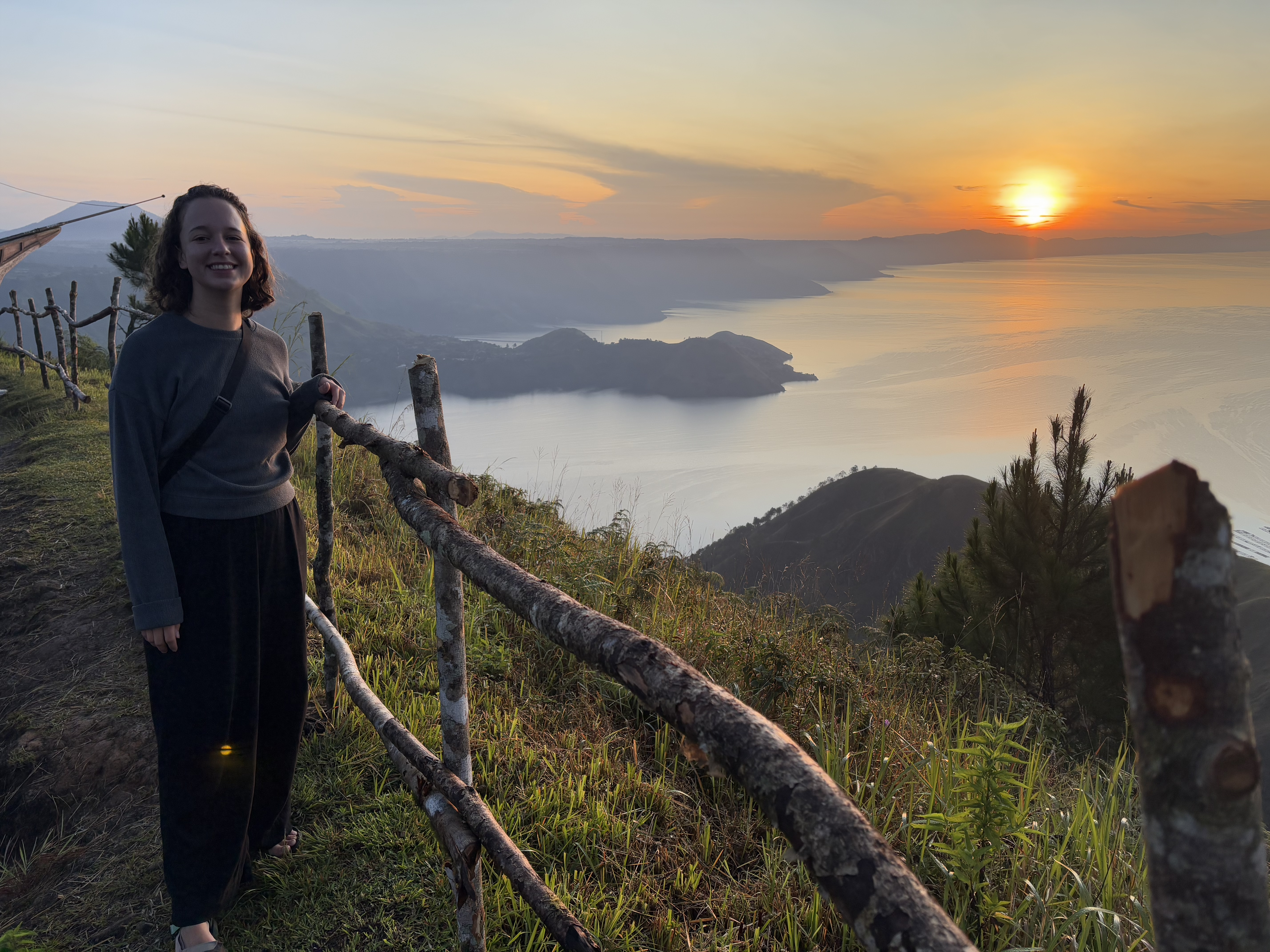
Anna enjoying a sunrise hike at Lake Toba, Indonesia, while attending an international aquatic research conference.
Her research brought her to France in the fall of 2021, where she sampled experimental ponds at the National Experimental Platform in Aquatic Ecology (PLANAQUA) to study how hypoxia (critically low oxygen) and planktivory (plankton predation) affect the daily zooplankton migrations. In 2023, she spent five months in Germany at the Leibniz Institute of Freshwater Ecology and Inland Fisheries (IGB), conducting experiments on diel vertical migration and zooplankton-mediated carbon fluxes.
Outside her graduate research, Anna has been deeply involved in the Global Lake Ecological Observatory Network (GLEON) throughout her Ph.D. She currently serves as co-chair of the GLEON Student Association, coordinating training and leadership opportunities for students across the network. In February 2025, she traveled to Lake Toba, Indonesia, for the annual GLEON All-Hands Meeting, where she organized and co-led a working group of international participants developing collaborative research ideas on freshwater plankton.
Q & A WITH ANNA SCHMIDT
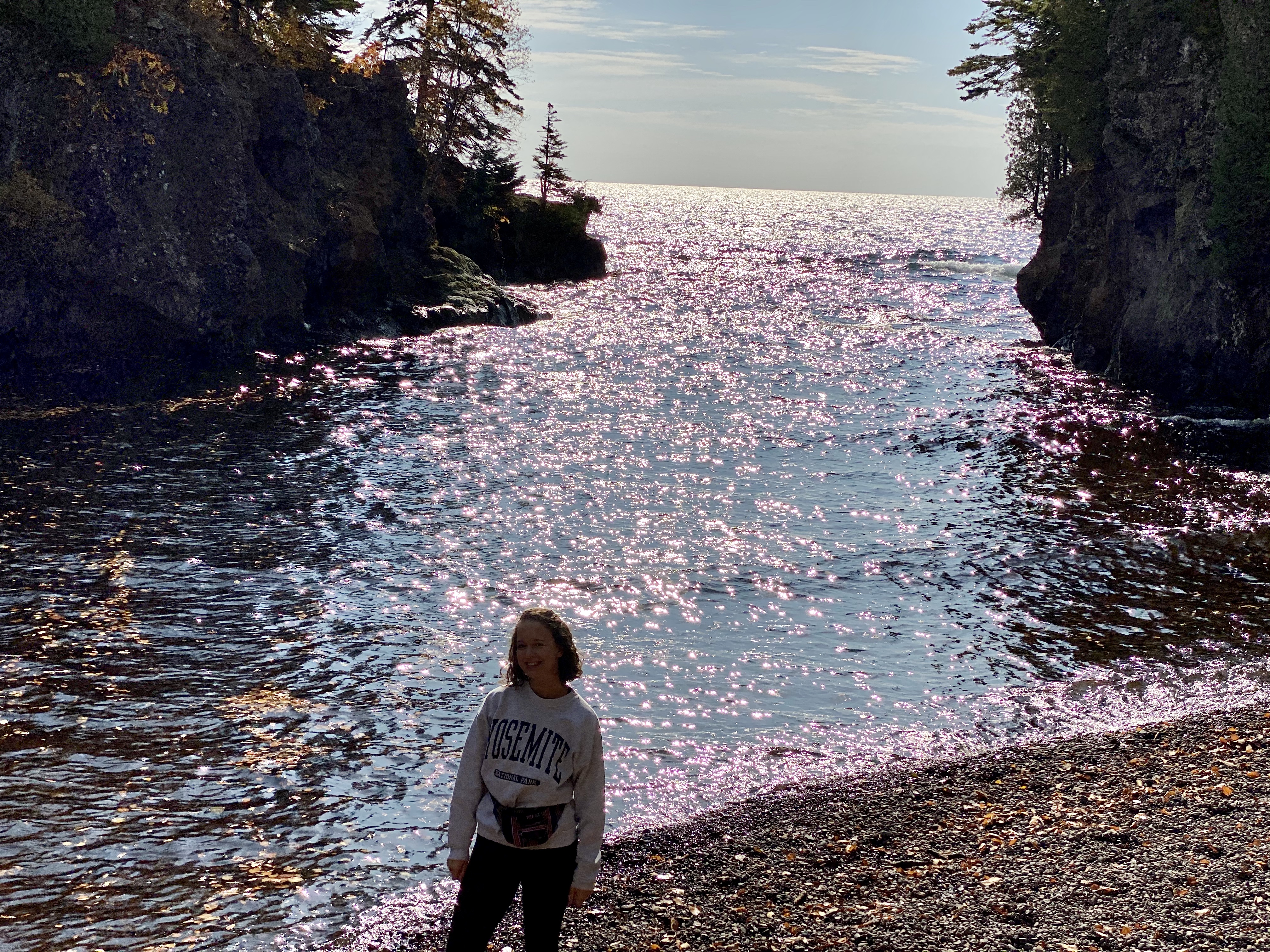
Anna at Temperance River State Park on the North Shore of Lake Superior.
Q: Which is your favorite Great Lake and why?
That’s a hard choice, but I’d have to pick Lake Superior as my favorite Great Lake! Growing up in southeastern Minnesota, I have wonderful memories of traveling with my family to Duluth and along the North Shore. There’s nothing quite like a crisp fall hike by the lake followed by a visit to Betty’s Pies in Two Harbors for a well-earned treat!
Q: Where did you attend college and what did you study?
I earned my bachelor’s degree in Biology and Environmental Sciences from the University of Wisconsin–Madison. As an undergraduate, I spent several years working in Dr. Trina McMahon’s laboratory, studying microbial community ecology in Lake Mendota. I collaborated with a Ph.D. student on research investigating how microbes transform mercury in lake ecosystems and conducted an independent project examining the gut microbiome of native and invasive zooplankton in Lake Mendota. That experience sparked my lasting interest in aquatic science research!
Q: What is your current position and what led you to pursue this career path?
I am currently a Ph.D. candidate in the Department of Biology at the Rubenstein Ecosystem Science Laboratory, University of Vermont. My research explores what drives zooplankton to migrate up and down in the water column each day and how these movements affect freshwater ecosystems. Understanding these patterns helps us better predict energy flow and nutrient cycling in lakes, which is important for managing fisheries and maintaining healthy aquatic ecosystems. I chose to pursue a Ph.D. because I love doing research and wanted the chance to dive deeply into a topic that fascinates me.
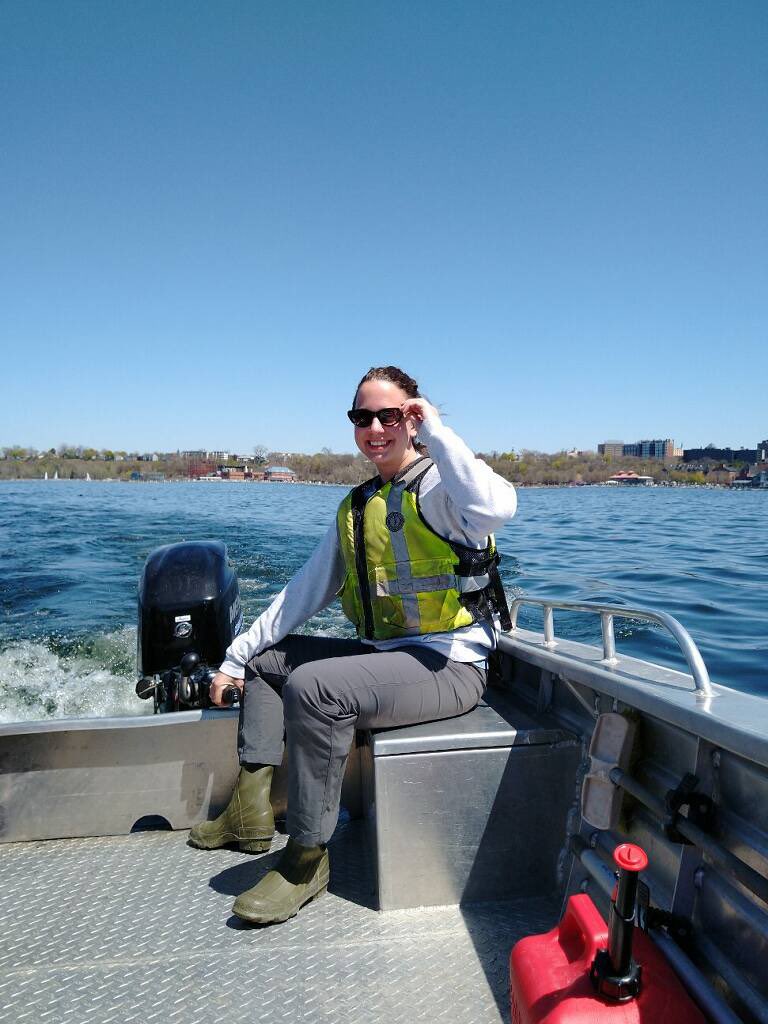
Anna heading out to do fieldwork on Lake Champlain.
Q: Why were you interested in working at CIGLR?
While earning my bachelor’s degree at UW–Madison, I explored career paths in ecological research and gained hands-on experience in aquatic fieldwork and lab work through a CIGLR Great Lakes Summer Fellowship. During my final semester, I applied for a Food Web Laboratory Analyst position at CIGLR, allowing me to continue my fellowship work and develop new skills with the fantastic team I had worked with.
Q: What advice would you give to someone interested in an environmental science career?
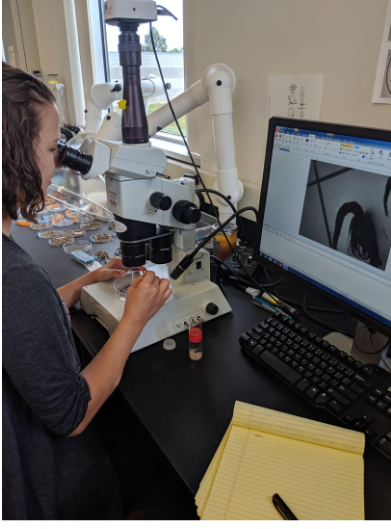
Anna examining Mysis under the microscope during her CIGLR Great Lakes Summer Fellowship.
My advice for anyone interested in this type of career is to remember that you never know where an experience might take you. During a trip to the Cornell Biological Field Station with Dr. Doran Mason, one of my Summer Fellowship mentors, I met a visiting student named Rosie Chapina. She was a Ph.D. student working with Dr. Jason Stockwell at UVM and suggested I check out UVM if I was thinking about grad school. That casual conversation ended up guiding me to apply to and eventually join Dr. Stockwell’s lab a few years later! The lesson I learned is that some of the best opportunities come from simply talking to people—those connections can open doors you never expected. In a way, I have my CIGLR Summer Fellowship to thank for leading me to my Ph.D. lab.
Q: What was your favorite part about working at CIGLR?
My favorite part about working at CIGLR was definitely the people! I have so many fond memories from my first summer, getting to know the other Summer Fellows, and later building connections with staff and scientists while working as a Food Web Laboratory Analyst. Fieldwork on Lake Michigan aboard the R/V Laurentian was unforgettable—not just learning the sampling techniques, but also enjoying the moments between shifts: playing cards, sharing stories, and laughing together. I even learned to play Euchre on the boat with a deck of Great Lakes-themed cards, which feels perfectly fitting for my time there!
Q: Is there anything else you would like to say?
As I mentioned, I have so many reasons to be grateful to CIGLR for helping guide my career to where I am today. Wishing everyone all the best, and I hope to catch up with some of you at the May 2026 Association for the Sciences of Limnology and Oceanography and the International Society of Limnology (ASLO-SIL) Joint Meeting in Montreal!
Related Articles and Resources:
-
- Schmidt, A.G.; I.M. Anderson; R. Bruel; R.J. Chapina; J.P. Doubek; S. Fiorini; S.K. Goldfarb; G. Lacroix; H.L. Wander; S. Zigic; J.D. Stockwell. 2025. Impacts of hypoxia and planktivory on crustacean and rotifer diel vertical and horizontal migration behaviors. Hydrobiologia. 852:2687-2707. (DOI:10.1007/s10750-024-05767-0).

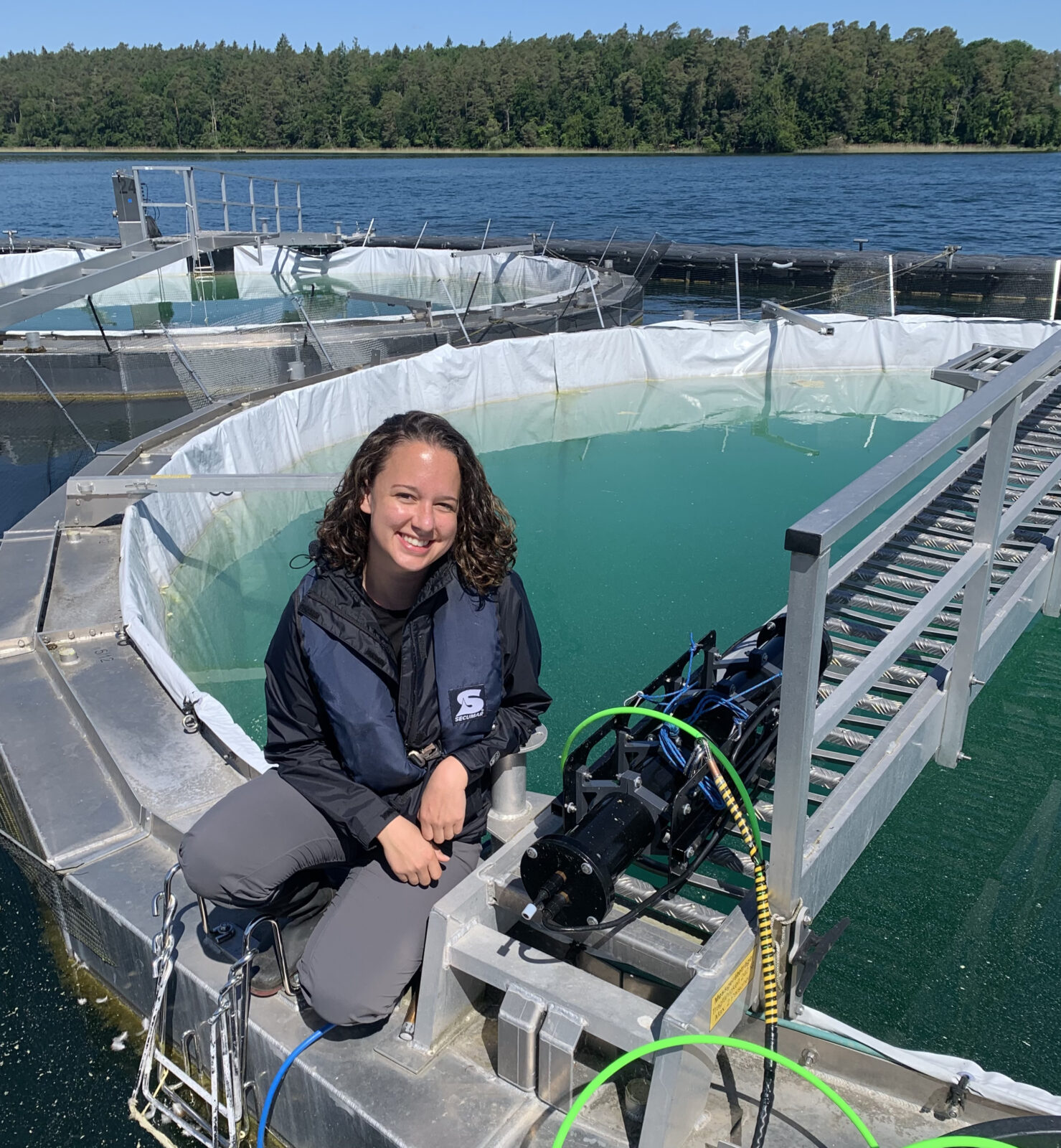
Anna with a plankton imaging instrument at the Leibniz Institute of Freshwater Ecology and Inland Fisheries (IGB) LakeLab experimental platform.
- UVM PhD Students Lead International Team in Carbon Flux Research: Mia McReynolds and Anna Schmidt conducted first-of-its-kind research at the IGB LakeLab in Germany. University of Vermont Rubenstein School of Environment and Natural Resources News. Alayna Howard. 4/17/24.