
Casey Godwin
Associate Research Professor
4840 S.State Rd.
Ann Arbor, MI 48108-9719
In the News:
- CIGLR’s Research Staff Provide Critical Information on Lake Erie’s Harmful Algal Blooms During the COVID-19 Pandemic, CIGLR Fall 2020 eNews, 12/22/2020
- Trump casts self as Great Lakes champion, but his policies may do lasting damage, MLive, 9/22/2020
- Working from H.O.M.E.S.: Great Lakes Research is Challenged but Carries On, CIGLR Winter 2020 eNews, 04/2020
- Water Lightning Talks, School for Environment and Sustainability, 5/13/2019
- Large outdoor study shows biodiversity improves stability of algal biofuel systems, Michigan News, 6/18/2018
- Biodiversity is Key to Growing Stable Algal Biofuel, New Study Shows, GineersNow, 7/2018
- Biodiversity boosts algal biofuel yields, Biofuels International, 6/20/2018
- Scientists Confirm that Biodiversity is Key to Growing Stable Algal Biofuel, Interesting Engineering, 6/18/2018
- Researchers at Ann Arbor’s U-M Find Biodiversity Improves Stability of Algae Biofuel Systems, dBusiness, 6/18/2018
- Large outdoor study shows biodiversity improves stability of algal biofuel systems, NewsWise, 6/12/2018
- Study: Too many nutrients make microbes less responsive, University of Minnesota News and Events, 12/11/2017
- In the wild, biodiversity’s power surpasses what experiments predict, Smithsonian Insider, 9/6/2017
- Alumnus research published in Nature, Cornell College News Center, 10/11/2017
- Biodiversity results in healthier, more productive ecosystems and can even help guard against extreme weather, EnvironNews, 9/27/2018
- Biodiversity results in healthier, more productive ecosystems and can even help guard against extreme weather, Natural News, 9/27/2018
- Biodiversity Just As Powerful As Climate Change For Healthy Ecosystems, ScienMag, 9/11/2017
- Species diversity reduces chances of crop failure in algal biofuel systems, Michigan News, 1/6/2017
- UM: Biodiversity proves its real-world value, Michigan Farm News, 10/3/2018
- Biodiversity Could Be As Important As Climate For Healthy Ecosystems, WMUK 102.1, 1/15/2017
- Species diversity reduces chances of crop failure in algal biofuel systems, ScienMag, 1/9/2017
- Forecasting Lake Erie Hypoxia, CIGLR 2018 Summer eNewsletter, 9/13/2014
Photo Gallery

Lake Erie hypolimnion water-the bottom layer of water-was sampled using Niskin bottles. The Niskin bottle samples were emptied into plastic bottles, & some filtered, for transport back to the laboratory. Pictured: Dack Stuart (left), Dr. Casey Godwin (right).

A portion of Dr. Godwin’s research at CIGLR & UM-SEAS involves collaboration with NOAA GLERL scientists to collect sediment and water samples from Lake Erie in an effort to learn more about the lake’s oxygen levels, specifically its hypoxia events. Photo Credit: Aubrey Lashaway.
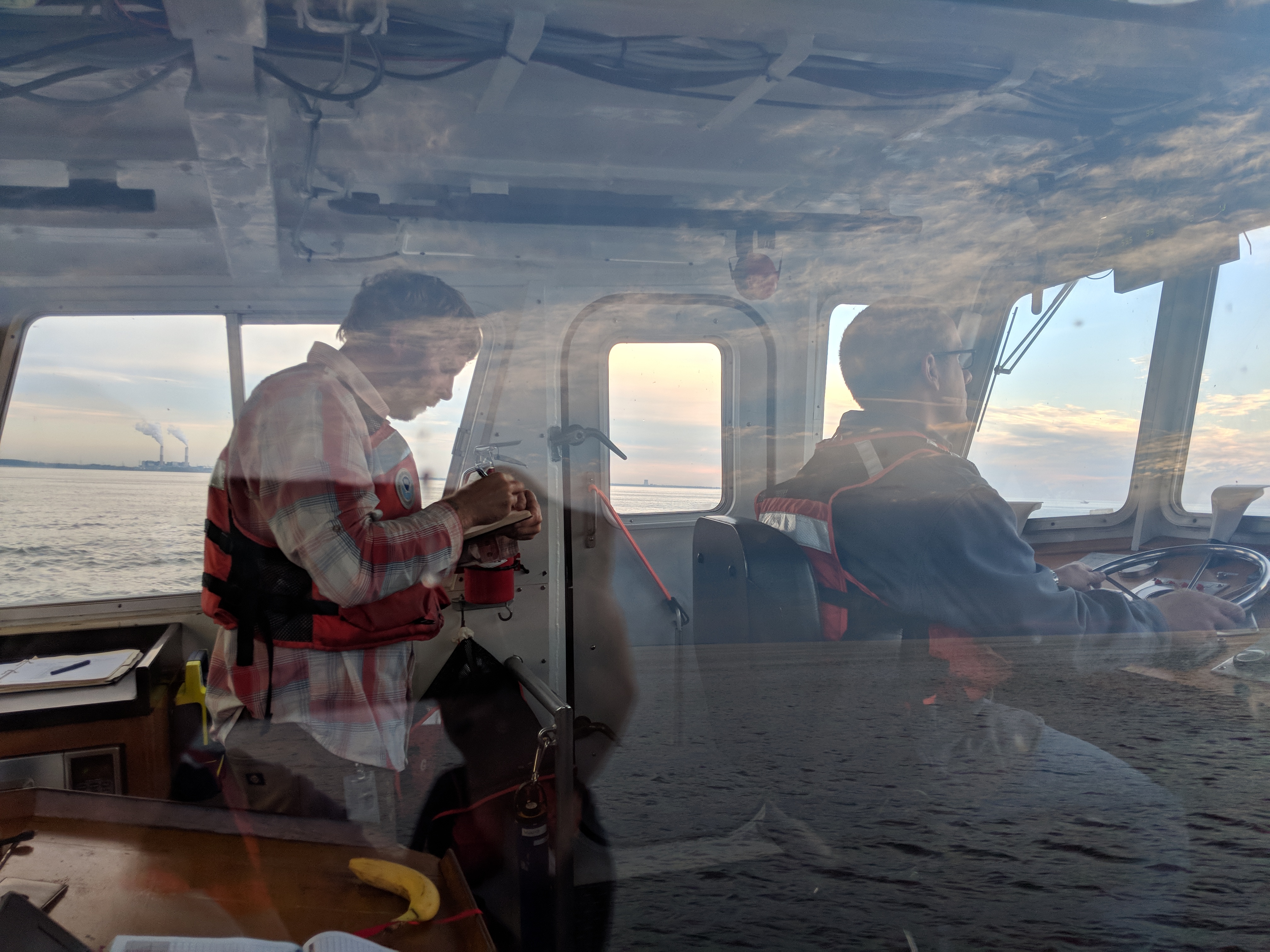
Heading out to collect sediment from Pictured: Boat Captain Daniel Burlingame (left), Dr. Casey Godwin (right). Photo Credit: Aubrey Lashaway.

Preparing the Lke Erie sediment sampling materials. Pictured: Boat Captain Daniel Burlingame (back), Russ Miller (middle left), Dack Stuart (middle right), Dr. Casey Godwin (front). Photo Credit: Aubrey Lashaway.

Preparing the Lake Erie sediment sampling materials. Pictured: Dr. Casey Godwin (left), Russ Miller (right). Photo Credit: Aubrey Lashaway.

Dr. Godwin (pictured right) and Dr. Thomas Johengen along with colleagues Russ Miller (pictured left) and Dack Stuart collect Lake Erie sediment using a box corer (center) which is designed to bring back a nearly intact sample of the lake bottom.
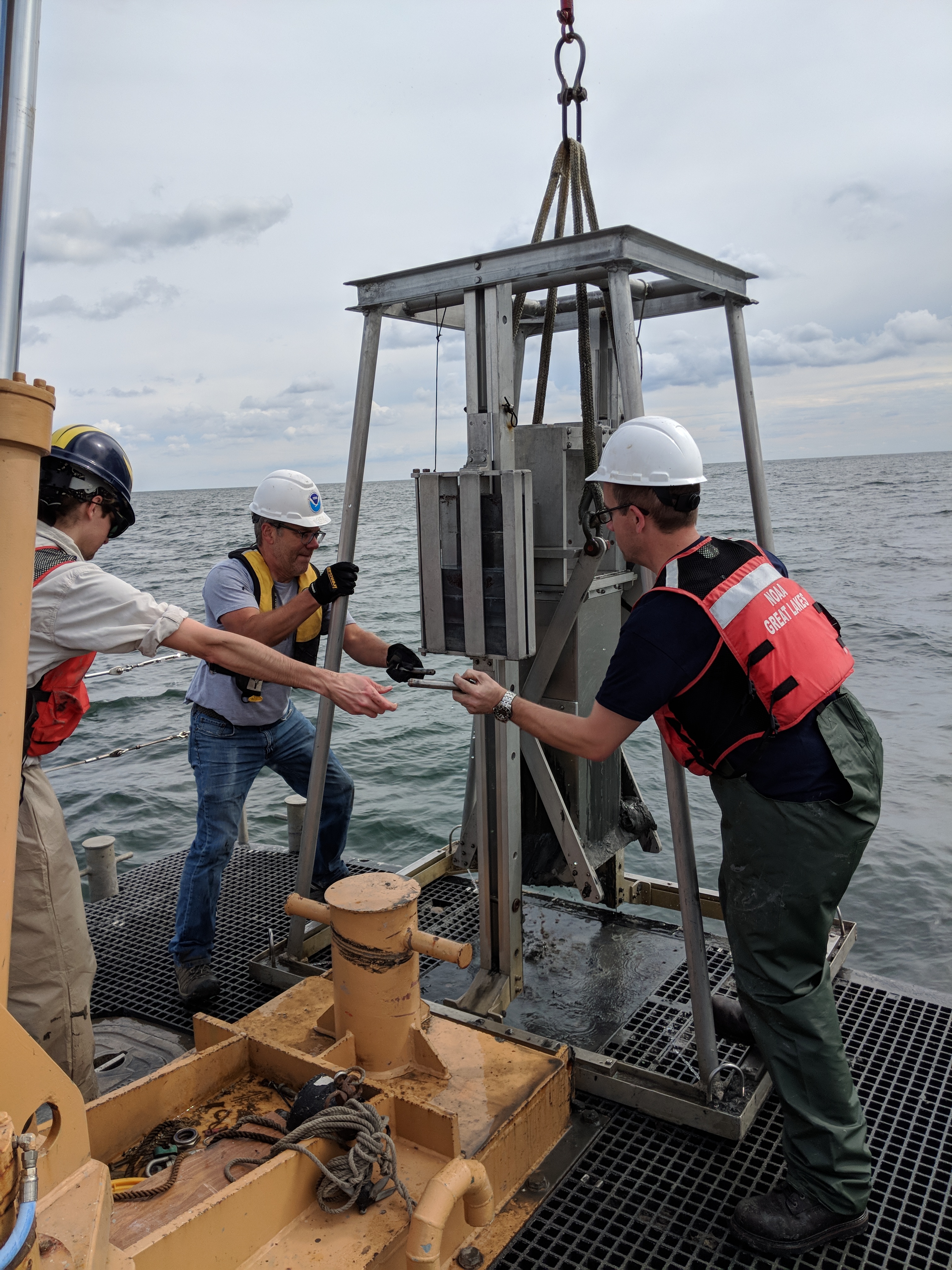
Pictured: Dack Stuart (left), Russ Miller (center), Dr. Casey Godwin (right).

Pictured: Dack Stuart (Left), Dr. Casey Godwin (Right).

Recently retrieved box corer with Lake Erie benthic sample.

Closer look at recently retrieved box corer with Lake Erie benthic sample.
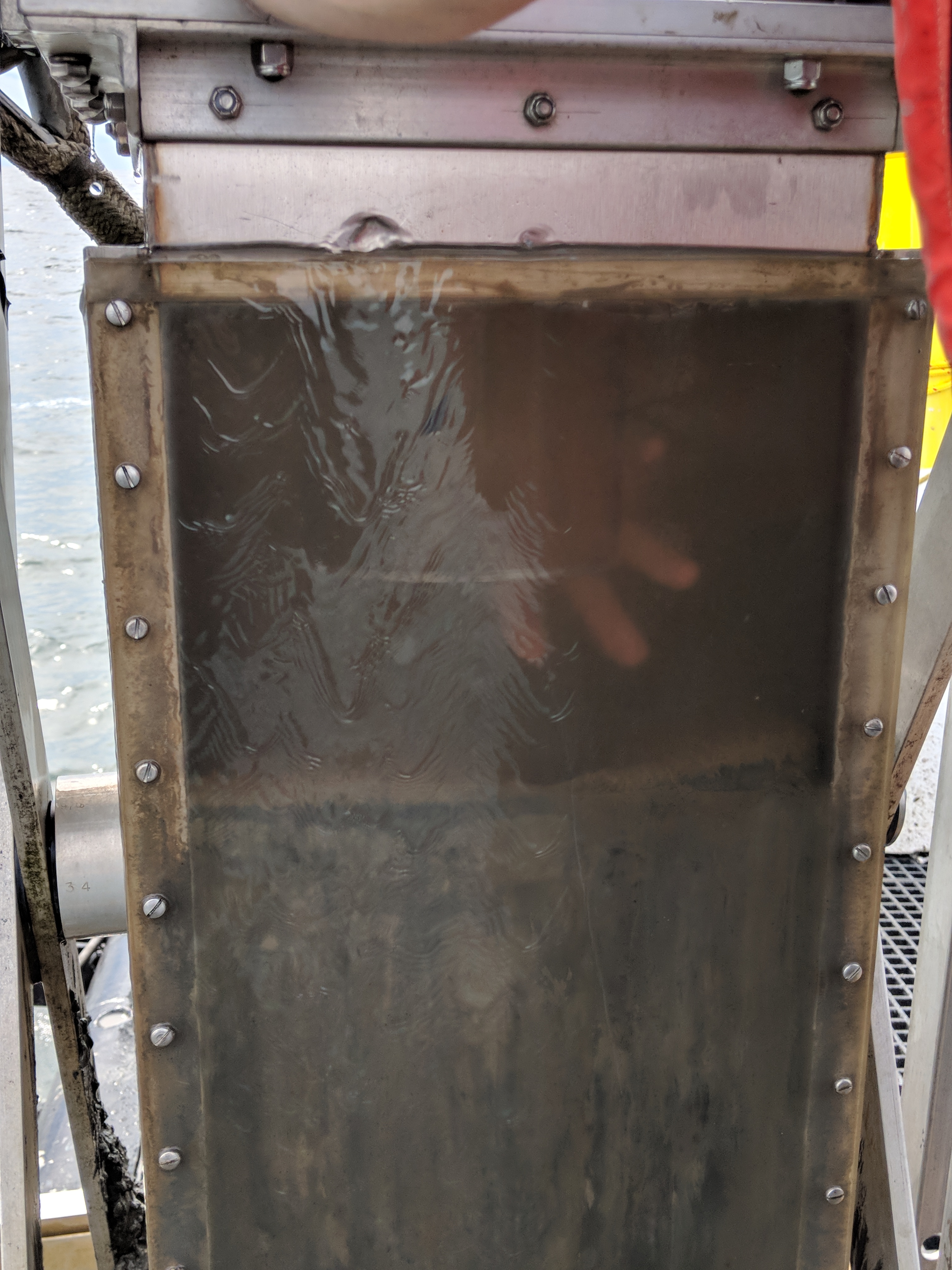
Individual cores were taken from the box corer for processing back at NOAA GLERL. In the lab, our scientists study Lake Erie’s sediment chemistry and oxygen demand.

Close-up view of sub core taken from the larger box corer. Photo Credit: Aubrey Lashaway.
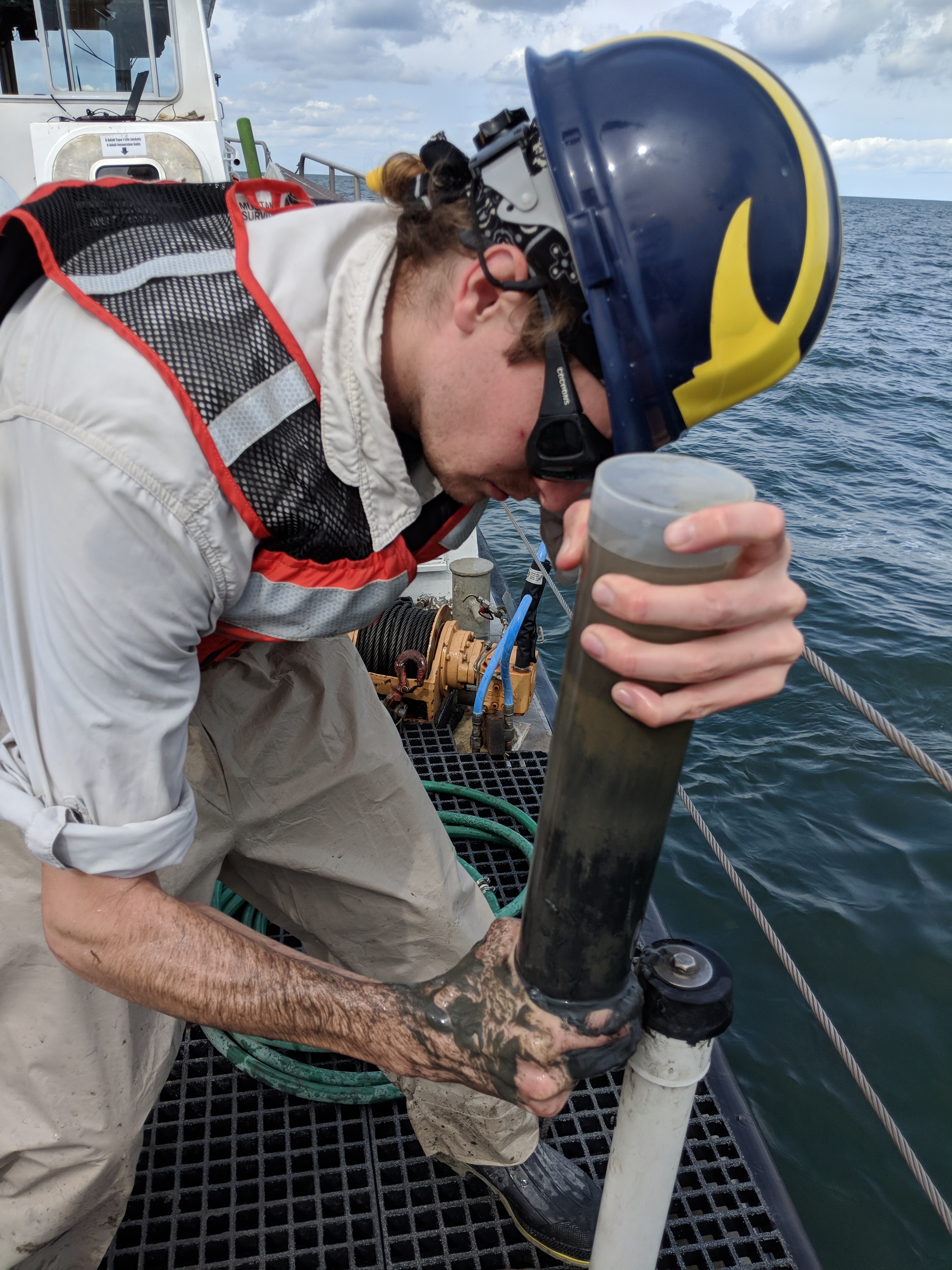
Collecting a sub sample from the sediment core collected from Lake Erie. Pictured: Dack Stuart. Photo Credit: Aubrey Lashaway.
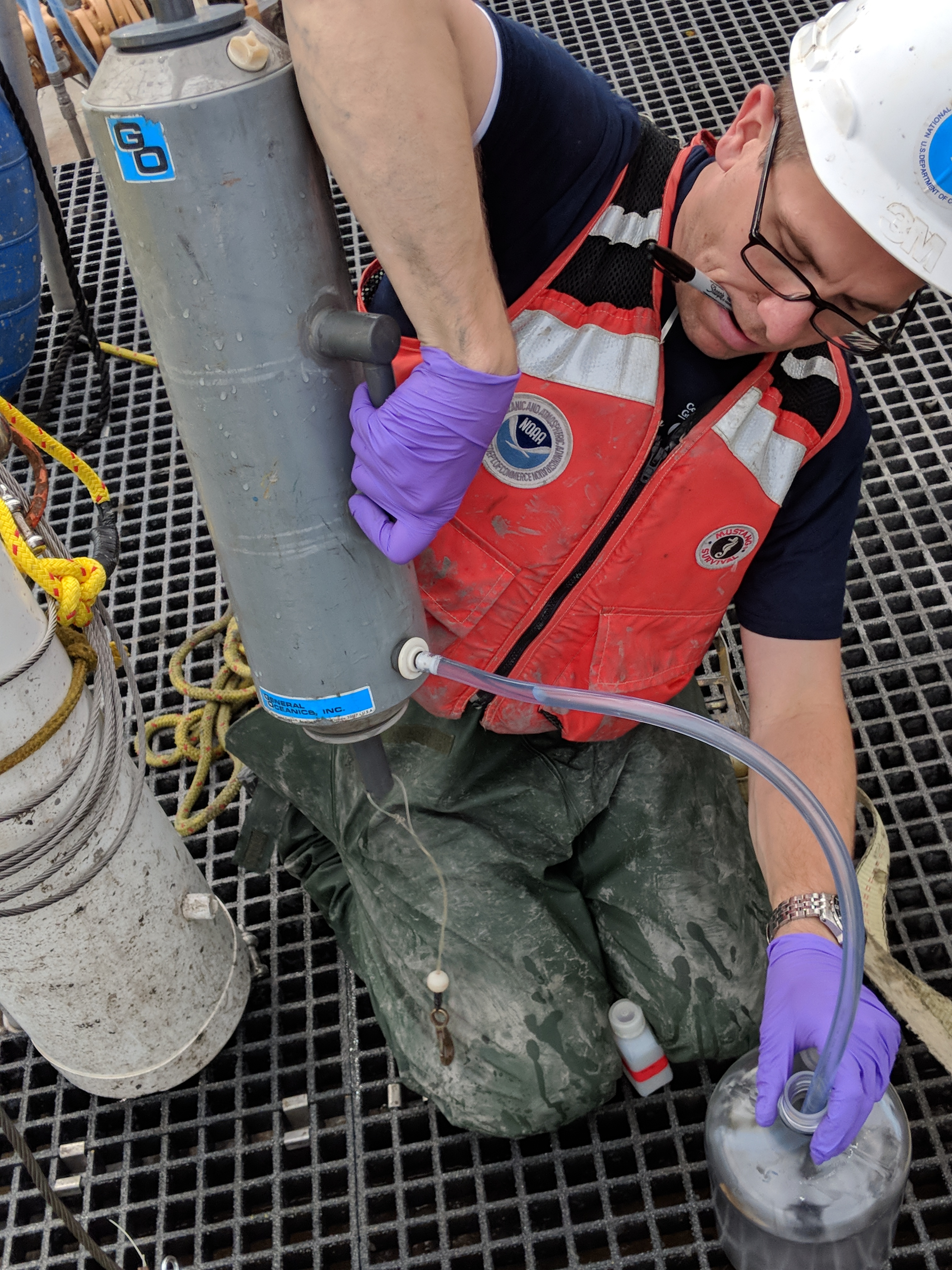
Collecting Lake Erie water from a Niskin Bottle Sampler. Pictured: Dr. Casey Godwin. Photo Credit: Aubrey Lashaway.

Pictured: Dr. Casey Godwin (left), Dack Stuart (right).

Preparing the Lke Erie sediment sampling materials. Pictured: Dr. Casey Godwin (left), Russ Miller (center), Dack Stuart (right). Photo Credit: Aubrey Lashaway.

As with all research, there’s always cleanup! Cleaning up the remaining sediment from the box corer. Pictured: Russ Miller (left), Dr. Casey Godwin (right). The researchers focus to collect sediment and water samples from Lake Erie in an effort to learn more about the lake’s oxygen levels, specifically its hypoxia events. Photo Credit: Aubrey Lashaway.
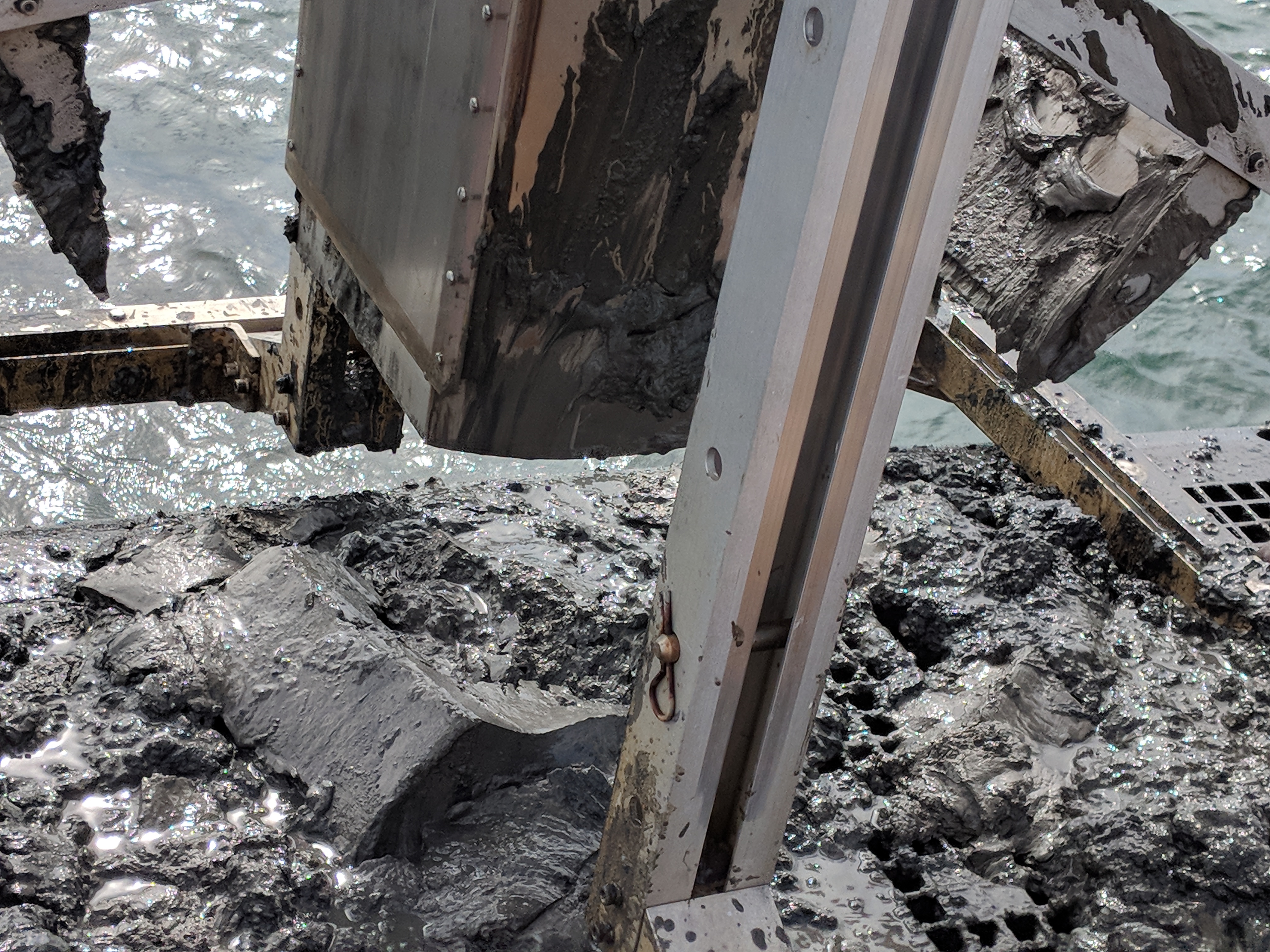
Cleaning up the remaining sediment from the box corer.

Pictured: Russ Miller (left), Dr. Casey Godwin (right).
Researcher Profile:
Dr. Casey Godwin has a Ph.D. in ecology, evolution, and behavior from the University of Minnesota. His research focuses on how the elemental requirements of bacteria and algae couple carbon and nutrient cycles in freshwater ecosystems. The driving question behind this work is “as we continue to pollute our aquatic ecosystems with excess nutrients, will cycling of carbon and other elements change in proportion, or will fertilization decouple key ecosystem processes?” He has examined this question in the context of impact of stream algae on nutrient retention within watersheds, functional diversity of freshwater bacteria in response to land use change, and most recently, minimizing the fertilizer demand of renewable fuels produced from algae. As part of CIGLR, he is working on projects including the effects of nutrient abundance and forms on harmful algal blooms and the influence of hypoxia on the biogeochemical cycling of nutrients and heavy metals in Lake Erie.
Education:
-
-
Ph.D. 2013, Ecology, Evolution, and Behavior, University of Minnesota, Saint Paul, Minnesota
-
M.S. 2006, Ecology, Pennsylvania State University, University Park, Pennsylvania
-
B.A. 2003, Biology and Environmental Studies, Cornell College, Mount Vernon, Iowa
-
Research Interest/Area of Expertise:
-
- Impacts of nutrient loading on biogeochemical processes in the Great Lakes
- Role of flexible biomass stoichiometry in coupling productivity and element cycling
- Physiological adaptations of aquatic microbes to nutrient starvation and surplus
Recent Publications:
Pu, T.; S.S. Keretz; A.K. Elgin; C.M. Godwin; M.D. Rowe; H.J. Carrick; P.W. Glyshaw; R.M. Pietscher; H.A. Vanderploeg. 2025. Dynamic energy budget (DEB) parameter estimation for the globally invasive Quagga Mussel (Dreissena rostriformis bugensis). Ecological Modelling. 505:111100. (DOI:10.1016/j.ecolmodel.2025.111100).
Isabwe, A.; T.J. Maguire; C.A. Stow; C.M. Godwin. 2025. Lake Erie summer chlorophyll phenology: a Bayesian additive regression trees comparison of growth and decay phases. Water Research. 282:123770. (DOI:10.1016/j.watres.2025.123770).
Den Uyl, P.A.; E.A. Kiledal; R.M. Errera; S.R. Chaganti; C.M. Godwin; H.A. Raymond; G.J. Dick. 2025. Genomic identification and characterization of saxitoxin producing cyanobacteria in western Lake Erie harmful algal blooms. Environmental Science & Technology. 59(15):7600-7612. (DOI:10.1021/acs.est.4c10888). [Altmetric Score]
Liu, Q.; M.D. Rowe; R.P. Stumpf; R. Errera; C. Godwin; J.D. Chaffin; E.J. Anderson; T. Pu. 2025. Ten‐year hindcast assessment of an improved probabilistic forecast system for cyanotoxin (microcystins) risk level in Lake Erie. Water Resources Research. 61(4):e2024WR038952. (DOI:10.1029/2024WR038952). [Altmetric Score]
Pu, G.; K. Shchapov; N.J.T. Pearce; K. Bowen; A. Bramburger; A. Camilleri; H. Carrick; J.D. Chaffin; W. Cody; M.L. Coleman; W.J.S. Currie; D.C. Depew; J.P. Doubek; R. Eveleth; M. Fitzpatrick; P.W. Glyshaw; C.M. Godwin; R.M. McKay; M. Munawar; H. Niblock; M. Quintanilla; M. Rennie; M.W. Sand; K.J. Schraitle; M.R. Twiss; D.G. Uzarski; H.A. Vanderploeg; T.J. Vick‐Majors; J.A. Westrick; B.A. Wheelock; M.A. Xenopoulos; A. Zastepa; T. Ozersky. 2025. The Great Lakes Winter Grab: Limnological data from a multi‐institutional winter sampling campaign on the Laurentian Great Lakes. Limnology and Oceanography Letters. 10(1):37-61. (DOI:10.1002/lol2.10447). [Altmetric Score]
Recent Presentations:
Godwin, C.M., J.R. Zehnpfennig, and D.R. Learman. 2020. Biotic and abiotic mechanisms of manganese (II) oxidation in Lake Erie, International Association for Great Lakes Research Virtual Meeting, June 10, 2020.
Kitchens, C. and C.M. Godwin. 2020. Timing and Rates of manganese flux from Lake Erie sediments, International Association for Great Lakes Research Virtual Meeting, June 10, 2020.
Godwin, C.M., D.C. Hietala, A.R. Lashaway, A. Narwani, P.E. Savage and B.J. Cardinale. 2017. Ecological stoichiometry of algal biocrude production: Polycultures balance tradeoffs in nutrient use efficiency. ESA Annual Meeting, Portland, OR, August 10, 2017.
Video Library
Where others see muck, University of Michigan biologists, ecologists and engineers see a potentially renewable source of biofuel in algae. They’re working to reduce engine emissions and shrink carbon footprints by refining an algal diesel fuel that works just as efficiently as its petroleum-based counterpart.
.
fdgj
University of Michigan scientists grew various combinations of freshwater algal species in 80 artificial ponds at U-M’s E.S. George Reserve near Pinckney, Michigan in the first large-scale, controlled experiment to test the widely held idea that biodiversity can improve the performance of algal biofuel systems in the field. Learn More: http://myumi.ch/JWQNk