

- This event has passed.
02/18/26: Using eDNA and population genomics to monitor the invasion of hemlock woolly adelgid throughout eastern North America.
Please join us for a Great Lakes Seminar Series – subscribe!
Time: 1:00pm – 2:00pm EST
Location: Virtual and NOAA Great Lakes Environmental Research Laboratory, Lake Superior Hall*
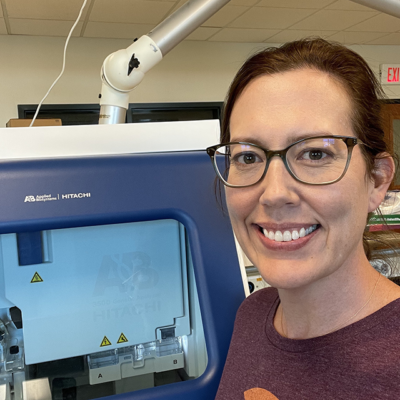
Presenter: Charlyn Partridge, Associate Professor at Annis Water Resources Institute – Grand Valley State University
Title: Using eDNA and population genomics to monitor the invasion of hemlock woolly adelgid throughout eastern North America.
About the presentation: Hemlock woolly adelgid (Adelges tsugae, HWA) is a small invasive insect threatening hemlock forests throughout the eastern United States and Canada. Eastern hemlocks are a foundation tree species found in sensitive coastal dunes and riparian zones. Once infested, HWA feeds on the nutrients of hemlocks, often resulting in hemlock mortality within 4 – 10 years. This can lead to landscape-level changes in biodiversity as infestations progress. Management efforts in Michigan are underway to control this invasive pest with a key focus on early detection. Current monitoring methods involve visual assessment of hemlocks for the presence of HWA ovisacs. However, this is a demanding task considering there are an estimated 170 million hemlock trees in Michigan. Our lab is using a combination of airborne environmental DNA (eDNA) methods and population genomics analysis to help detect new infestations and gain insight into the historical spread of HWA throughout eastern North America. The information we gain from our work, will hopefully contribute to faster detections and more accurate range expansion models as HWA continues to spread throughout the Great Lakes region.
About the speaker: Dr. Charlyn Partridge is an Associate Professor at Annis Water Resources Institute – Grand Valley State University. Her research uses genetic and genomic tools to aid in conservation and management efforts. Her current projects involve using environmental DNA approaches for targeted species detection and understanding how invasive species rapidly adapt to new environments.
Registration is not required
_____________________________________________________
*IMPORTANT VISITOR INFORMATION
As of July 2025 the GLERL facility can no longer accept visitors for the Great Lakes Seminar Series due to staffing shortages. Please attend virtually using the link above.
All seminar attendees are required to receive a visitor badge from the front desk at the NOAA Great Lakes Environmental Research Laboratory facility. Attendees need to present a valid U.S. photo ID or green card. If you are a Foreign National, we encourage you to attend virtually. For questions regarding building access, please email Margaret Throckmorton at [email protected]. Additional questions? Contact Margaret Throckmorton: [email protected]; visit ciglr.seas.umich.edu for more information.