
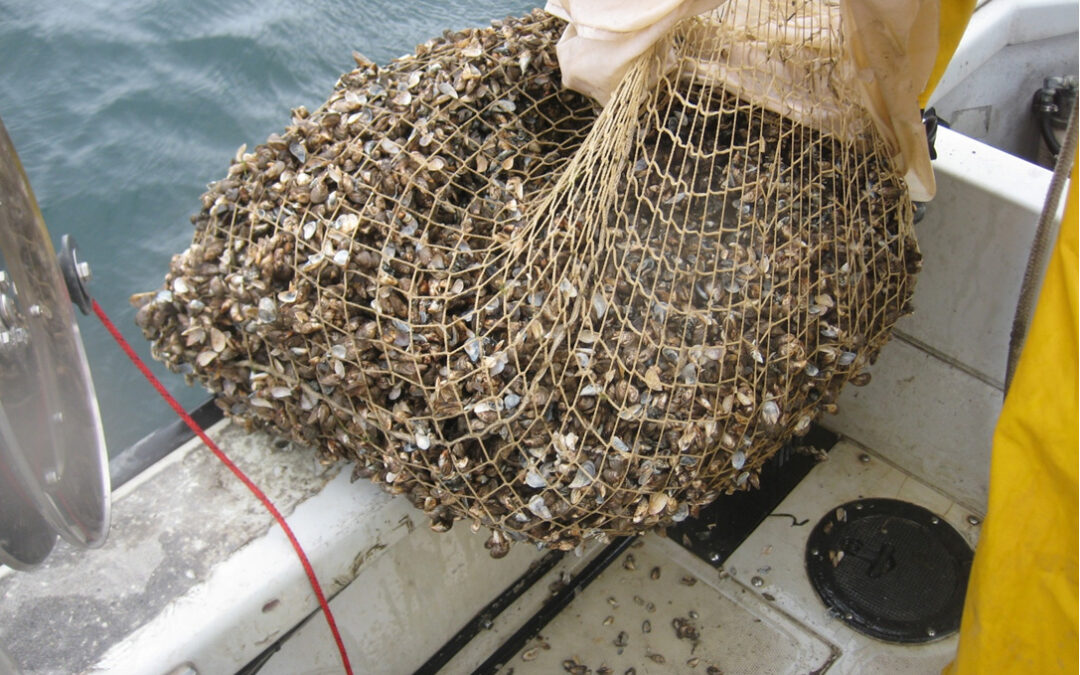
In western Lake Erie’s dynamic and ever-changing ecosystem, an under-the-surface relationship may help explain why toxic blooms of Microcystis have become increasingly common in recent years. A recent study led by former CIGLR Algal Toxin and Ecology Research Specialist Anna Boegehold, PhD, alongside NOAA GLERL colleagues Paul Glyshaw, Reagan Errera, PhD, and Scientist Emeritus Hank Vanderploeg, PhD, explores the complex interactions between invasive quagga mussels and genetically distinct strains of Microcystis aeruginosa. Their findings shed new light on how these relationships may promote cyanobacterial dominance and highlight the many stressors shaping freshwater ecosystems.
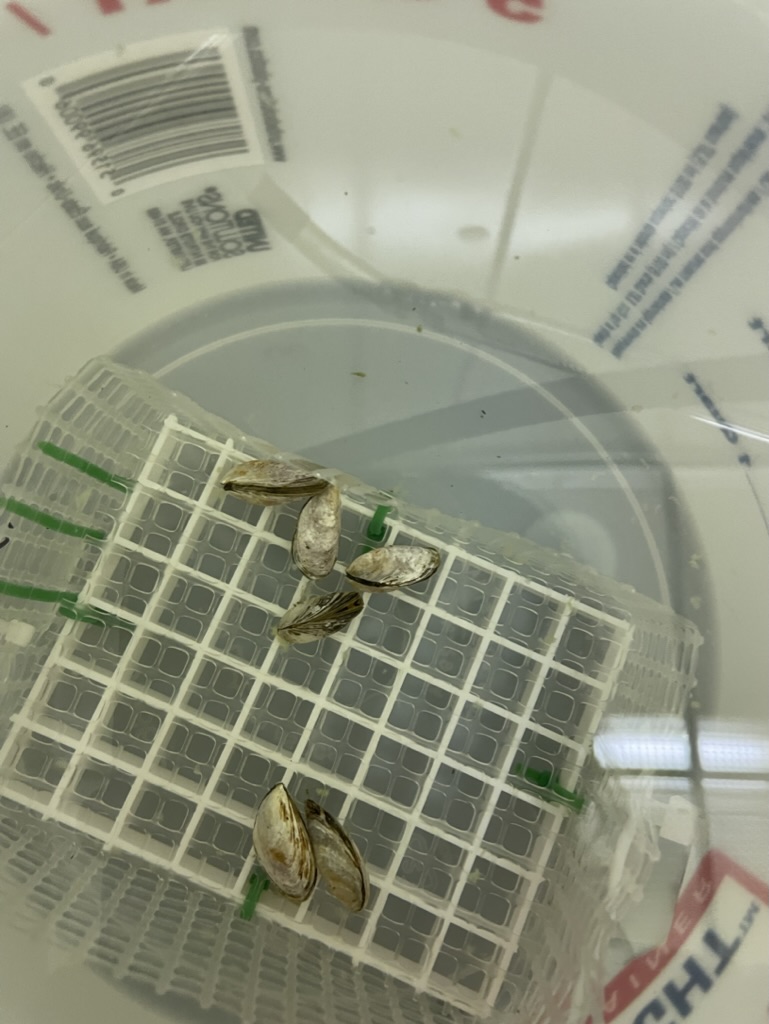
Upon arrival at the laboratory, quagga mussels were gently cleaned and stored in a stock tank for use in carefully controlled lab experiments.
Invasive dreissenid mussels, like the quagga mussel, have long been known as powerful ecosystem engineers. Introduced to the Laurentian Great Lakes in the late 1980s alongside the more familiar zebra mussel, they have significantly reshaped phytoplankton communities. By filtering out preferred food sources such as diatoms and green algae, while often rejecting cyanobacteria like the toxic Microcystis aeruginosa, these mussels have shifted the balance of the western Lake Erie ecosystem. As quagga mussels have become the dominant dreissenid species in much of Lake Erie, they play a key role in influencing phytoplankton dynamics. Until now, it remained unclear whether quagga mussels would eventually begin consuming Microcystis when other food became scarce.
To investigate this, the research team collected quagga mussels from Lake Erie and used seven genetically distinct strains of Microcystis aeruginosa from the Western Lake Erie Culture Collection at the University of Michigan. In carefully controlled lab experiments, they paired these strains with the green alga Chlamydomonas oblonga to observe feeding behavior. The mussels quickly consumed the green algae but did not switch to eating Microcystis, even when the green algae were depleted. Notably, strains of Microcystis that produced microcystins, the toxins characteristic of harmful blooms, also suppressed mussel feeding on the green algae, suggesting that the toxins or another metabolite act as a deterrent.
“This lack of prey switching is significant,” said Boegehold. “It shows that the mussels remain selective even during food scarcity. Instead of becoming opportunistic, quagga mussels continue to avoid cyanobacteria, a behavior that could allow Microcystis to thrive once other phytoplankton have been removed from the system.” This consistent selectivity may help explain the recurring dominance of Microcystis aeruginosa in shallow, nutrient-rich systems like western Lake Erie and Saginaw Bay in Lake Huron.
“Our research shows that quagga mussels selectively avoid feeding on toxic Microcystis even when preferred algae are scarce, highlighting how multiple stressors combine to shape harmful algal blooms and ecosystem health in Lake Erie.”
– Anna Boegehold, PhD
By depleting green algae and diatoms, mussels disrupt the natural competition among phytoplankton species. This opens up a niche that Microcystis is well-positioned to fill. The ongoing avoidance of toxin-producing strains, even when preferred food is unavailable, suggests that compounds such as microcystins not only deter consumption but may also play a role in shifting community dynamics, indirectly promoting blooms through altered mussel feeding behavior.
“While reducing phosphorus and nitrogen inputs remains critical, we also need to consider the influence of invasive mussels, and potentially find ways to manage their effects. Understanding which Microcystis strains are present could help too, since mussel feeding responses vary by strain.”
“Moving forward, our team sees a need to explore the chemical ecology of western Lake Erie blooms by determining what is causing the changes in quagga mussel feeding behavior, whether it’s microcystin or another metabolite produced by Microcystis aeruginosa,” said Boegehold. “We also see a need for broader lab trials with a more diverse range of phytoplankton to better understand whether mussels might begin feeding on cyanobacteria under more extreme or prolonged food scarcity.”
As invasive species and harmful algal blooms continue to challenge the health of the Great Lakes, understanding and addressing these layered interactions will be essential to protecting water quality, ecosystem function, and public safety.