
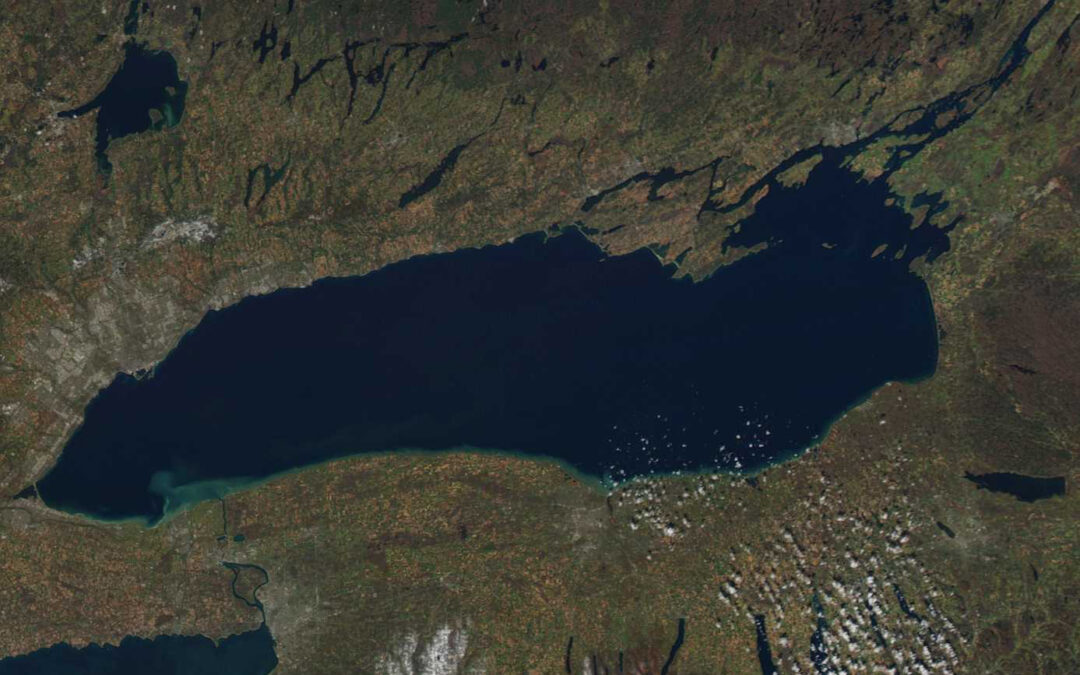
When strong winds sweep across Lake Ontario, the water does more than churn at the surface, it hums.
Those winds generate waves, and those waves press down on the lakebed, sending tiny vibrations through the Earth. People can’t feel them, but sensitive instruments can. In a new study led by Chu-Fang Yang, a former CIGLR-funded postdoctoral researcher in the Department of Earth and Environmental Sciences at the University of Michigan, along with scientists Zack Spica (UM EES), Ayumi Fujisaki-Manome (UM CIGLR), and Yaolin Miao (UM EES), showed that a telecommunication fiber-optic cable on the bottom of the lake can act like a massive scientific instrument, tracking how storm waves grow, organize, and fade in real time. Yang is now a researcher at Géoazur Laboratory and affiliated with CNRS and Université Côte d’Azur in France. The study was published in Communications Earth & Environment.

Former CIGLR-funded postdoctoral researcher, Dr. Chu-Fang Yang.
Rogue waves and extreme storm waves are among the most dangerous natural hazards in oceans and large lakes. Understanding how these waves form is critical for improving forecasts and protecting ships and lakeside communities.
“Wind-driven waves don’t stop at the surface,” Yang said. “They carry energy from the air, through the lake, and even into the ground below.”
How Wind Builds a Wave
Every large wave begins as a ripple. These tiny ripples, called capillary waves, form when wind first blows across the water’s surface. Surface tension shapes them into delicate patterns.
If the wind continues and travels far enough over the water, a distance known as fetch, those ripples grow into larger waves. Energy shifts from short, chaotic waves to longer, more organized ones, and under the right wind speed, direction, and duration, they can build into powerful storm waves.
This growth is constant and dynamic. Waves interact with the wind, with each other, and with shorelines, gradually shifting their energy toward lower frequencies and longer wavelengths as they strengthen. “We can actually see this shift happening in the vibration data,” Yang explained. “The lake tells us when waves are organizing and gaining strength.”
When Waves Shake the Ground
These vibrations, called microseisms, have been observed in oceans and large lakes worldwide. In this study, researchers detected high-frequency vibrations linked to chaotic, choppy waves early in a storm, as well as lower-frequency vibrations associated with larger, more organized wind waves. Often, the high-frequency signals appear first, giving an early indication that bigger storm waves are forming.
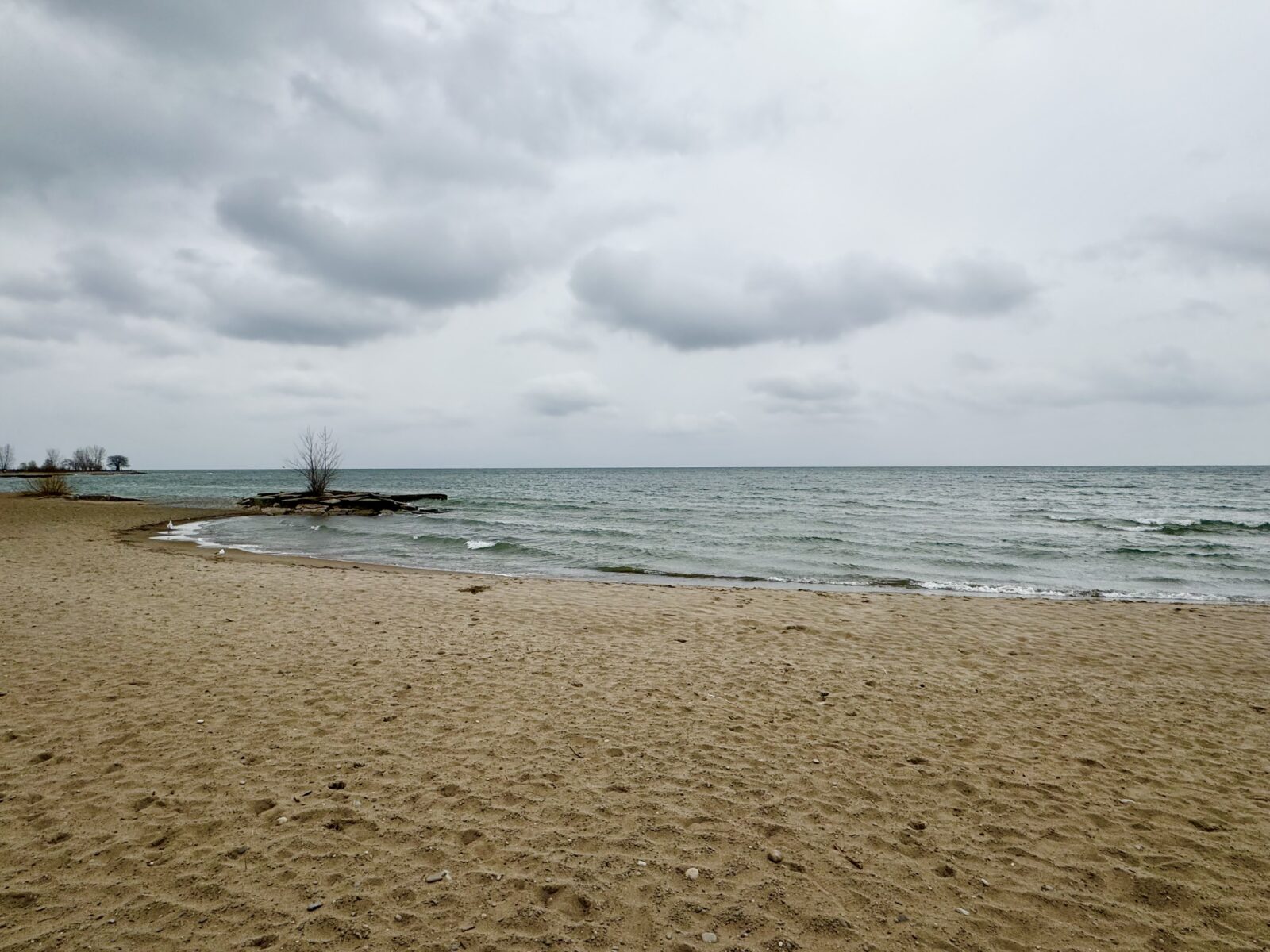
Woodbine Beach near Toronto on Lake Ontario, where the fiber-optic cable enters the water and extends along the lakebed. Credit: Chu-Fang Yang.
Turning a Fiber-Optic Cable Into a Giant Sensor
To capture these signals, the team used a 50-kilometer fiber-optic cable along the bottom of western Lake Ontario near Toronto. Using Distributed Acoustic Sensing, or DAS, they transformed the cable into a dense vibration sensor with nearly 5,000 measurement points spaced every 10 meters.
Unlike traditional buoys, which are typically removed during the winter season, even though it is a prime time for severe storms, the lake-bottom cable stays in place, observing wave activity across tens of kilometers in real time. “Because the cable is already there for telecommunications, carrying internet and phone signals across the lake, we can turn existing infrastructure into a scientific observatory with meter-scale resolution,” Yang said.
This is one of the first studies using fiber-optic cables in the Great Lakes to track storm waves, a clever way to repurpose everyday technology for science.
Why Wind Direction and Distance Matter
The study revealed how important wind direction and fetch are for wave growth. Lake Ontario is longer east to west than north to south. When winds blow along the lake’s long axis, waves have more room to grow and become stronger. When winds blow across the shorter axis, waves remain smaller, even if wind speeds are high.
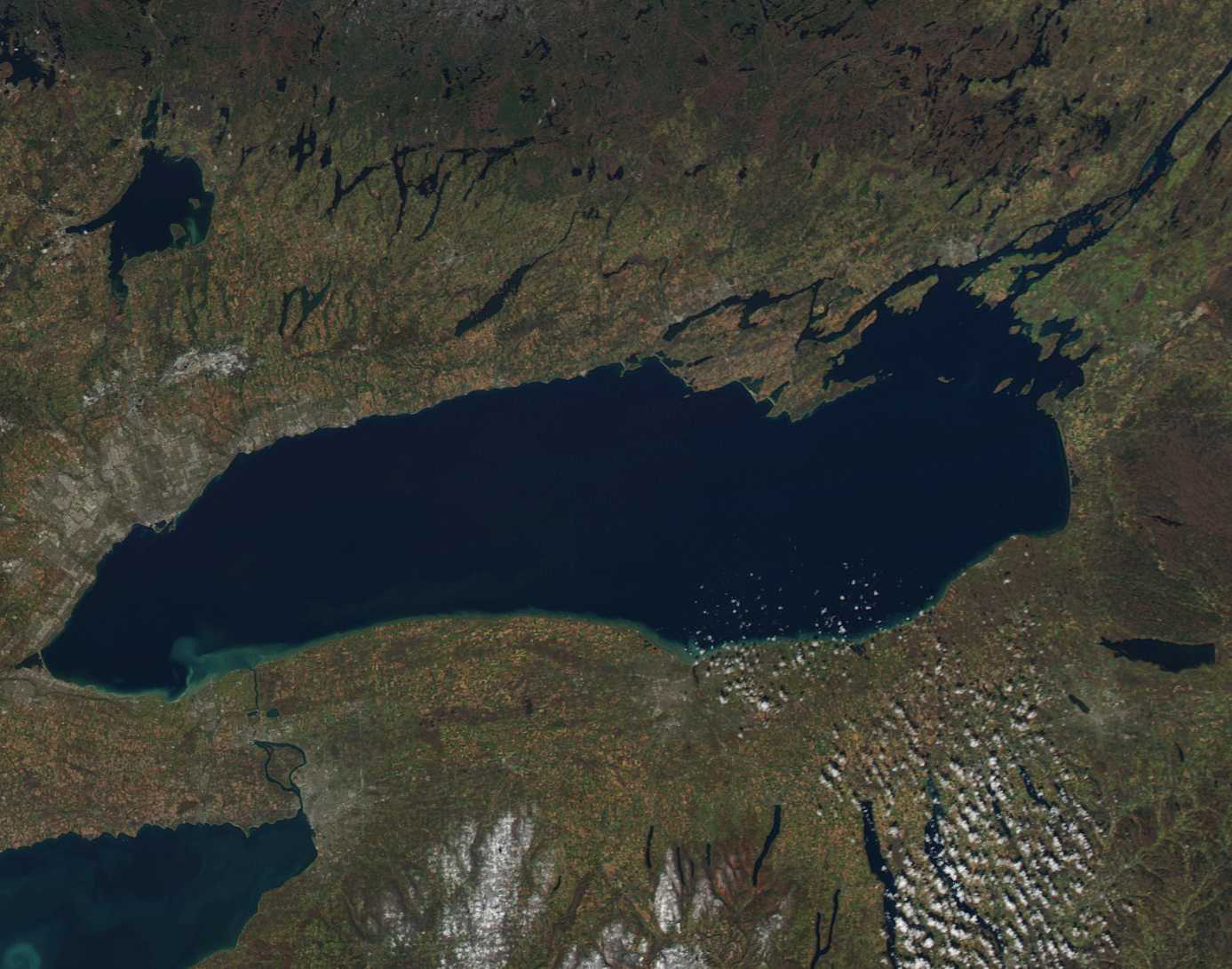
MODIS satellite image of Lake Ontario, November 2, 2014. Credit: NOAA Great Lakes CoastWatch.
By tracking how vibration frequencies changed across the lake, researchers could see waves strengthen, peak, and eventually fade. They also compared the cable data with forecasts from NOAA, the National Digital Forecast Database, and the WAVEWATCH III Great Lakes wave model, finding that the vibration patterns closely matched predictions.
A New Tool for Storm Monitoring
Storm-driven waves threaten ships, offshore structures, and lakeside communities. Measuring waves during severe weather has always been challenging. Fiber-optic cables resting safely on the lakebed offer continuous, high-resolution monitoring without exposure to surface damage.
“The lake has its own rhythm,” Yang said. “With fiber-optic sensing, we’re finally able to hear it clearly.”
This research not only opens a window into the hidden dynamics of storm waves but also offers a powerful new tool for early warnings, better forecasts, and safer navigation on Lake Ontario. As extreme weather events become more frequent, methods like this could help communities prepare and respond.
Resources
-
- Yang, C.F.; Z. Spica; A.Fujisaki-Manome; Y. Miao. 2026. Fiber-optic Observations Capture Wind Wave Evolution in Lake Ontario. Communications Earth & Environment. 7:159. (DOI:10.1038/s43247-026-03182-y). (Journal Article)
- Monitoring Lake Ontario Using Distributed Fiber-Optic Sensing: A Novel Technique to Monitor Waves in the Great Lakes, 2024 CIGLR Annual Magazine Seed Funding Summary, Page 22. (Magazine Article)
- Distributed Acoustic Sensing Data Acquisition at the Bottom of Lake Ontario, 2024 CIGLR Annual Magazine Postdoc Fellows Summary, Page 33. (Magazine Article)
Funding
This research was supported by the CIGLR postdoctoral fellowship program and Seed Funding (NOAA grant NA22OAR4320150) and partially by the USGS (award G23AP00498).